http://world4.eu/parisian-fashion-1450/

https://faireladiesfairelords.com/product-category/womens-renaissance-costumes/

https://commons.wikimedia.org/wiki/File:Lais_of_Corinth,_by_Hans_Holbein_the_Younger.jpg
One thing that made clothing-making more advanced was the use of tailors. Clothes became an investment and something that had to be taken care of. Many tailors began to form business networks. Another technological advance in the clothing of the Renaissance was the use of math, especially geometry. Vitruvius, a famous architect, discovered that the human body represented perfect proportions. For example, someone’s wingspan should equal their height, ideally. Clothing was made in order to fit these proportions. Finally, because communication and transportation improved and became faster, clothing was more easily and quickly available.
Something that I think could be considered a technological advance in the 21st century is the idea of fast fashion. Many people nowadays want clothing that is inexpensive, so clothing is produced in mass quantities and cheaply. Things are not made to last, but rather to be worn for a short amount of time, since trends change so quickly.


Greek civilizations were wealthy, inventive, and valued perfection, which means they valued decoration like many other civilizations. They were highly decorated, especially with lots of gold jewelry. While Greek people did wear a lot of white, symbolizing classiness and cleanliness, they also wore brightly colored fabrics too. Priests and nobility would wear long, colored gowns for special occasions. During the dark ages of Greek civilization, it is infers that they wore simpler clothing, like shawls and wrap skirts. This makes sense, because highly fashionable and decorated clothing would not have been a priority. From the jewelry to headpieces, and colorful clothing, the style of Greece reflects the kind of people they were – classy and inventive.
I think people would make things by hand through spinning, weaving, etc. because it’s a fun activity to them and they get satisfaction knowing where their clothing comes from and that they made it by hand themselves.
I have done sewing projects and cross-stitching, but the only time I ever made clothing was for a fashion class I took my freshman year of high school. I had to make a pair of pajama shorts, and while they didn’t turn out perfectly, I thought it was fun to learn how to sew and make something by hand. It was more challenging than I anticipated!
Some benefits to making things by hand is knowing that the clothing you are wearing did not come from the often unfair labor of someone else. Like I said before, it also could be a fun hobby for someone or a way to reduce stress.
A similarity between the two societies is that they both liked to be highly decorated with things like various jewelry, such as necklaces and bracelets, and headpieces. Both societies also had similar cylindrical silhouettes of clothing. Often times, fabric was draped around the body and secured with a belt or pinned into place.
A few differences between the societies are the types of cloth that was used, and the use of wigs. Egyptians used a lot of linen in their clothing, while people from Mesopotamia wore a lot of wool. Furthermore, Egyptians sometimes shaved their heads and wore wigs, while those in Mesopotamia did not.
The main reason for the differences in the fabrics used was availability. The linen that many Egyptians wore came from the flax plant. Many people from Mesopotamia wore wool, which makes sense since many of the farmers were sheep-herders. Additionally, Egyptians shaved their heads because they were obsessed with cleanliness, while those in Mesopotamia did not, because while they lived in a relatively clean society, they weren’t as concerned with cleanliness as the Egyptians.

This is a depiction of a man who we can infer was a part of the upper class in early Egypt due to his skirt with a triangular shape called a “shenti”. https://www.brooklynmuseum.org/opencollection/objects/3551

This is a falcon head end-piece of a necklace that was from 1938-1759 BCE. I choose this image since decoration was important to the Egyptians. https://www.brooklynmuseum.org/opencollection/objects/3523

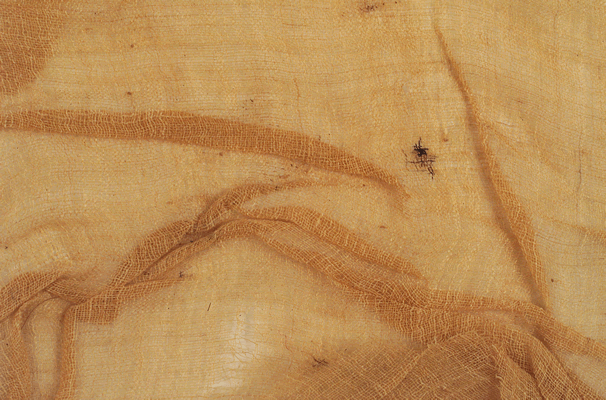
This is a piece of the linen King Thutmose II was wrapped in when he was buried. I thought this was a good thing to include, since linen was a staple in Egyptian clothing. https://www.ucl.ac.uk/museums-static/digitalegypt/textil/archive/uc55044A.gif
The clothing we choose to wear is most often dependent on the occasion or where we are going/what we are going to be doing. For example, you wouldn’t wear the same thing you wear on a night out to church on Sunday. There are unwritten rules about what is appropriate for different events and occasions. This doesn’t mean you are not allowed to wear certain things, but you will probably get some weird looks from people and you might even be asked to change your outfit.
One of the most interesting things surrounding our clothing is what we choose to wear around the different members of our families. When you are lounging around your house on a lazy Saturday afternoon, a tee shirt and sweatpants is a good way to go. However, if you are going to a dinner at your grandparents house, it is likely you would wear something a little nicer and more put together. I think this is because we are around our immediate family more often than our extended one and overall we tend to feel more comfortable in our own homes.
The example I choose of something that would not be acceptable to wear to the dining hall is a clear floral dress over a black bandeau and mini shorts. While this outfit might be okay if you were going to a New Year’s party, you would definitely get some stares in the dining hall if you showed up wearing this.

 SSmyth THEA 237 - HoCaF